

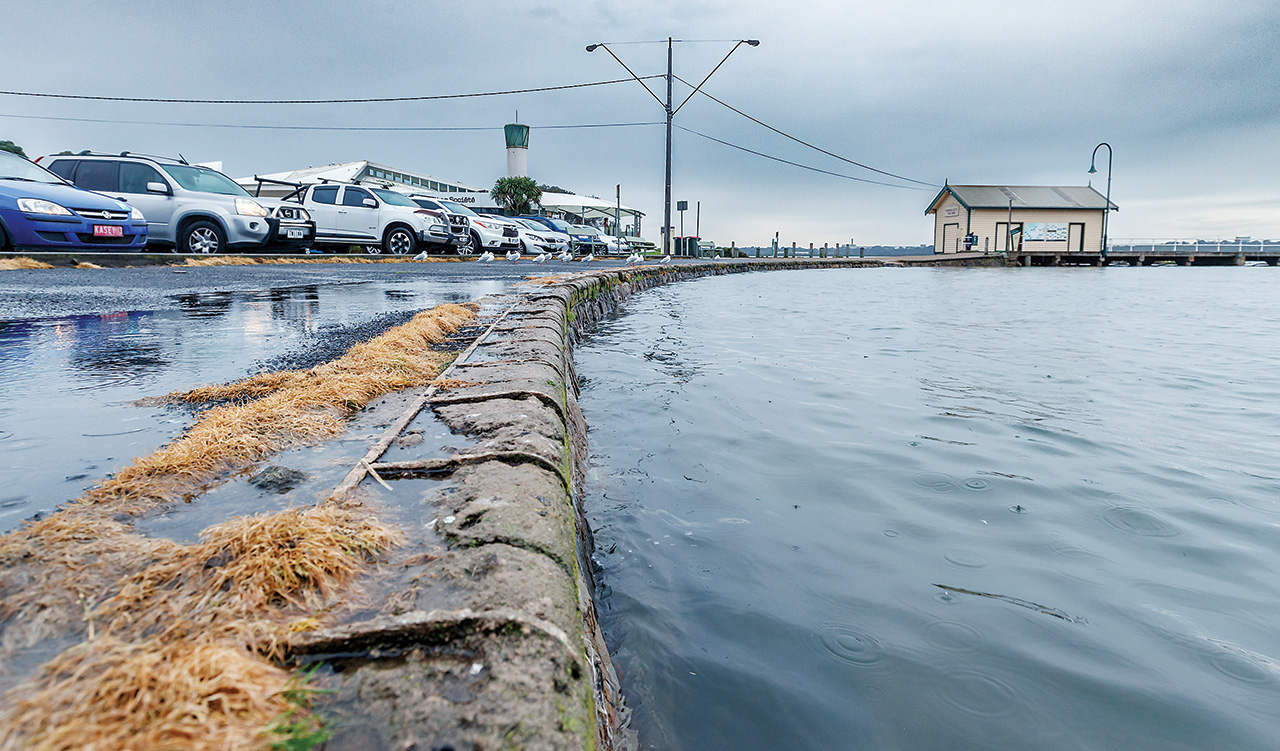
BUILDINGS in towns on the Western Port coast and inland will in future need to undergo a coastal hazard and vulnerability risk assessment (CHVRA) before they can be approved.
In what is believed to be a first for Victoria, permit applicants will be required to plan for predicted climate change effects such as sea level rises and erosion. Under the new rules allowance must be made for a sea level rise of not less than 0.8 metres by 2100 and for the combined effects of tides, storm surges, coastal processes. Permit applications in low lying and vulnerable areas will be referred to Melbourne Water, which has its own criteria for floor levels and safety.
Mornington Peninsula Shire Council this month adopted guidelines to make sure it is “safe for … development to be constructed where sea level rise hazards are identified” in Western Port. The guidelines also cover “adaptation measures” to reduce risks, requiring that protective works do not detrimentally impact coastal processes.
Cr Sarah Race, who successfully moved that council adopt the requirement for proposed developments to have a CHVRA, said it was a “great response to the lack of a response from the state government [to climate change]: we’ll have tools in place when it comes to coastal hazards and coastal planning issues”. “A lot of other councils are very interested to see what we’re doing in this space, so it’s a really exciting move forward,” said Race. “Insurance on coastal land will be really expensive and even banks may stop mortgaging properties on coastal locations. So, if the properties can show they can deal with these vulnerabilities, that’s going to be great for our peninsula as well.”
Cr Kate Roper said the peninsula’s ten per cent of the state’s coastline included “some really tricky areas”. Cr David Gill said the effects of climate change — inundation, land use, future of beaches — was “possibly most important thing we deal with”. He said the council did not want to stop development, [but] “we want them to have guidelines about how they can build on a block for the lifetime of that dwelling or that building”.
“We also want to be aware of where we may not want people to build, because it won’t work,” Gill said. “Because this is a creeping matter, it’s not something that comes tomorrow, but it creeps over generations or at least over decades. “Our awareness needs to be there and we need to talk to people about it and the guidelines will do that for us.” Gill said Melbourne Water and the state government made the ultimate decisions about land use.
Cr Susan Bissinger said she had “lived through many catastrophic predictions: global cooling, we were going to have an ice age; global warming, we were going to be cooked by now”. “It would do no harm to prepare for climate change and predicted changes, although the guidelines were ‘a little restrictive’. “If you over exaggerate the problem and over anticipate, that is far better than being caught out in the end,” Bissinger said. “It’s still an even bet. You look at images taken 20, 30, 40 or 50 years ago and they’re almost exactly the same when you take the aerial shots now.
“So, it’s a very controversial way to think, but … the best I can see how to make a decision is first to do no harm. “There are plenty of chicken littles out there, where the sky has fallen, but I think if we’re making our own assessment and just acting on the side of caution rather than not, I don’t see a problem.”
First published in the Mornington News – 27 August 2024
