

The state Planning Minister, Sonya Kilkenny, has approved an interim erosion overlay for the Mornington Peninsula that critics say is deeply flawed, potentially misclassifying tens of thousands of properties as landslide-prone despite council acknowledging errors in outdated mapping and raising concerns about “anomalies”.
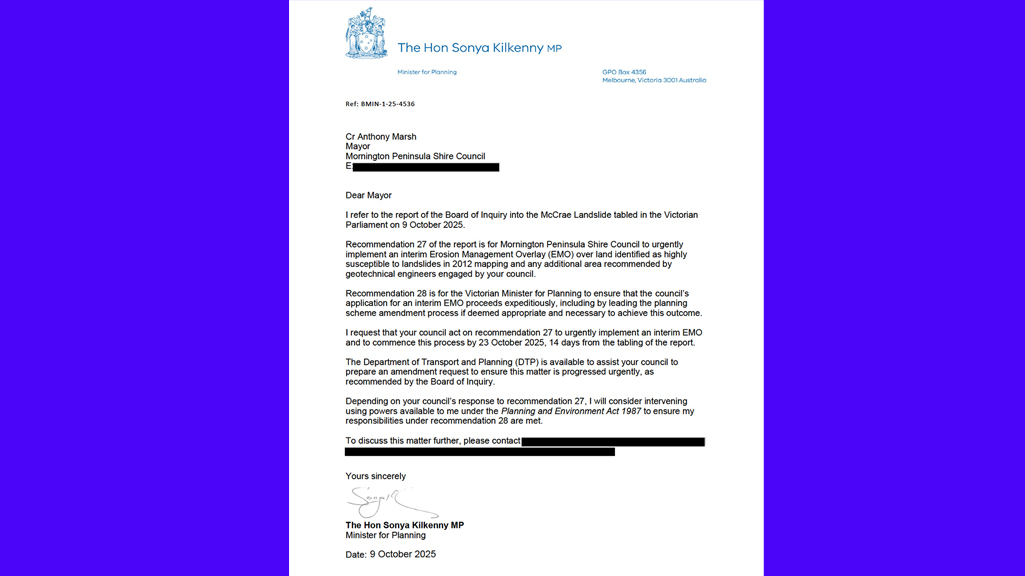
The approval comes after a letter from Kilkenney in October, obtained by The News, gave the shire just 14 days to implement an EMO, or face state government intervention.
Described by some as a major “overreach”, the interim erosion management overlay (EMO7) targets land assessed as highly susceptible to landslides, affecting about 33,000 lots. Of these, roughly 27,000 are residential properties not already covered by existing erosion overlays.
Many residents have expressed anger and confusion after their properties were suddenly included, with many believing they face no landslide risk at all.
The News has been told the overlay extends to areas such as small 30cm retaining walls, flat asphalted residential streets, built-up piles of garden waste and otherwise flat land.
Planning Minister Sonya Kilkenny approved the interim overlay after councillors voted in favour of it at an unscheduled meeting on 17 November.
The planning control was a key recommendation of the board of inquiry into the McCrae landslide in January, which saw a house slide down the escarpment.
Kilkenny issued the urgent directive requiring the shire to amend the Mornington Peninsula planning scheme to introduce the interim overlay direction which applied to “land identified as highly susceptible to landslides in 2012 mapping and any additional area recommended by geotechnical engineers engaged by your council”, according to a letter from Kilkenny to mayor Anthony Marsh dated 9 October, obtained by The News.
“I request that your council act on recommendation 27 [of the Board of Inquiry report] to urgently implement an interim EMO and to commence this process by 23 October 2025, 14 days from the tabling of the report,” the letter stated.
“Depending on your council’s response to recommendation 27, I will consider intervening using powers available to me under the Planning and Environment Act 1987 to ensure my responsibilities under recommendation 28 are met.”
When the overlay was approved at the November council meeting, Marsh said the “interim control will help minimise the risks posed by development on landslide-susceptible land”.
“While an erosion management overlay would not have prevented the McCrae landslide, which was caused by a burst water main, it was a recommendation of the board of inquiry. Council has accepted the inquiry’s recommendations in relation to implementing the erosion management overlay,” he said.
However, errors in the mapping system were revealed after the plan was submitted, raising questions about the accuracy of the risk assessments and prompting significant community backlash.
It remains unclear whether the shire was aware of the issues with the old mapping when the overlay was created. The News has sought clarification as to whether council raised these concerns with the Planning Minister or sought additional time to correct the data.
In response to growing concern, councillors passed an urgent business motion on 16 December acknowledging community frustration and called on the state government to accelerate a review of the “data errors” and mapping accuracy.
Speaking to his motion, Cr Bruce Ranken said community angst had intensified and needed urgent attention, particularly as the next scheduled council meeting was not until February.
“Many landowners report receiving notice of overlay applications on land they consider flat or not at risk, raising concerns around the methodology of mapping and the accuracy of the underlying data,” he said.
In a statement following the state government’s approval of the overlay, the shire said it was “aware of some anomalies in the mapping used for the interim erosion management overlay”.
“For example, retaining walls and other minor earthworks with an artificially steep slope have been picked up as being highly susceptible to landslides,” it said.
“The shire is working to remove these anomalies as a matter of priority and will then ask the Minister for Planning to revise the EMO7 to reflect the refined mapping this year.”
“In the interim – council will be supporting residents by waiving application and enquiry fees where EMO7 is the sole permit trigger and further geotechnical analysis and/or permit conditions are not required to address the underlying risk.”
The shire also confirmed that EMO7 was a temporary measure until a revised permanent EMO was introduced “after a comprehensive shire-wide review of landslide susceptibility data and mapping (also known as Stage 3 of council’s review and update of EMOs on the Peninsula)”.
In the meantime, the council said in many cases only a small portion of a property would be affected.
“This means development can occur in the usual way on the rest of the site not covered by EMO7, subject to any other relevant planning controls,” it said.
“If a planning permit is required, an application will likely need to include a report from a geotechnical expert explaining how the proposed development will be safe from landslide risk. However, council can vary or lessen requirements if they are not relevant to the assessment.”
Two online petitions have since been launched opposing the interim overlay and calling to “protect our peninsula”.
Mornington MP Chris Crewther raised the issue in Parliament on 2 December, urging Kilkenny to explain why 27,000 Mornington Peninsula properties were suddenly flagged as being at landslide risk.
“It’s extremely disappointing that the state Labor Government’s Minister both requested council to produce an interim erosion overlay based on 2012 mapping following the McCrae Inquiry, and then approved that overlay, despite two petitions against it (one sponsored by me),” he said.
Crewther said a response to his parliamentary question, due 1 January, remained unanswered, as did “hundreds of emails against approving it from locals and me”.
“This means 33,000 properties impacted, including properties deemed as highly susceptible to landslide risk that only have small retaining walls, piles of debris, basically flat land, and more,” he said.
“I am hopeful that council can finalise an updated and accurate erosion overlay as soon as possible, keeping only properties actually susceptible to landslide as they’ve committed to do, to replace this current overlay.
“Despite the Minister’s decision, it is good that the council has committed to give permit cost exemptions while this interim overlay is in place.
“The government should also give resources and assistance to council to speed up the process of producing a replacement accurate erosion overlay as soon as possible.”