

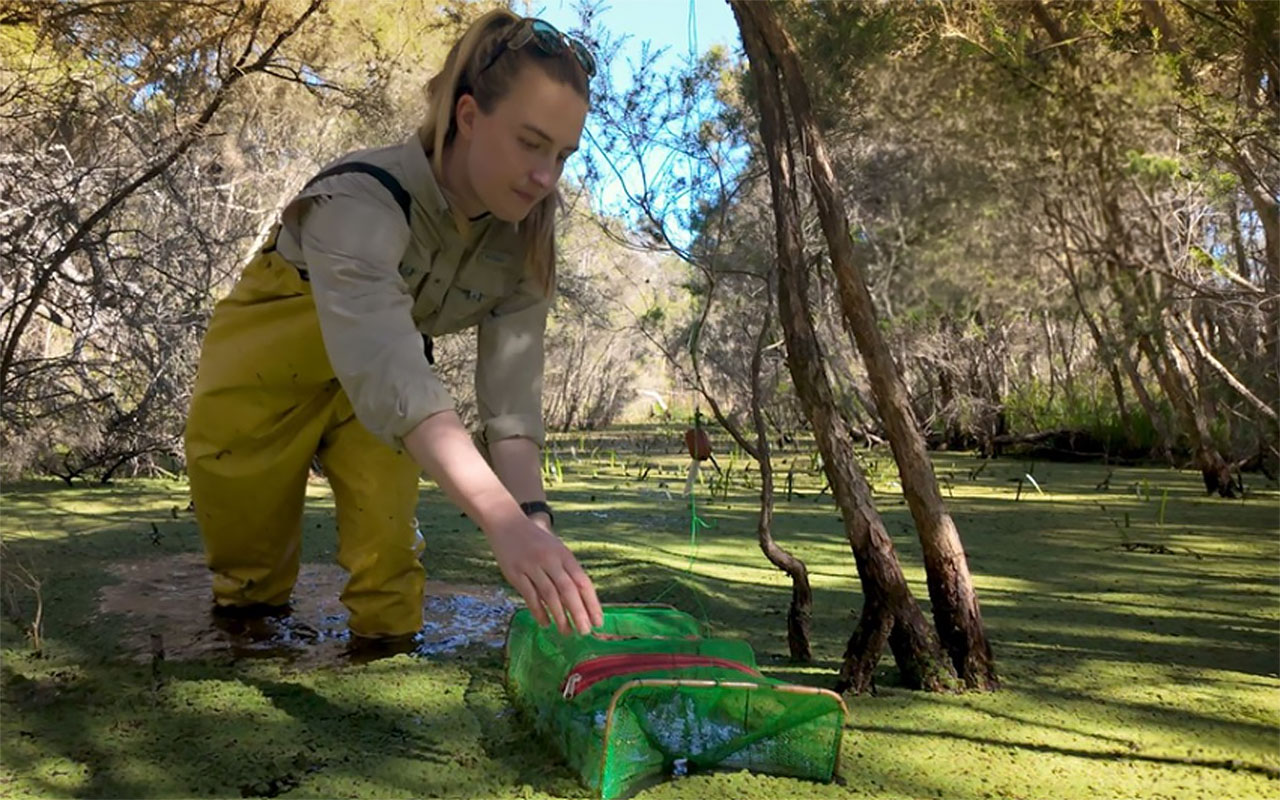
NUMBERS of an endangered fish at The Briars in Mount Martha have grown from around 40 to more than 400 in a single breeding season, following a wetland management project headed by Briars Conservation and Wildlife Lead, Lachlan Gordon, and aquatic ecologist Gemma Walker from Ecology Australia.
The eastern dwarf galaxias is listed as endangered at both state and national levels. The species grows to a maximum length of 3-4cm and was first translocated to The Briars during the Peninsula Link project in 2011.
The team reshaped the water environment to better aligning conditions with the fish’s breeding cycle.
“It’s an exceptional outcome,” said Gordon.
“It shows the wetland conditions are now closely aligned with what the species needs to survive and reproduce.”
Gordon said the team had expected the water changes to lift numbers, but not by this much.
“We were confident that the water regime improvements would lead to an increase, but the scale and speed of the response definitely exceeded expectations,” he said.
“To see that kind of jump in a single season highlights just how resilient the species can be when the conditions are right.”
The changes involved adjusting how water enters, moves through and is retained within the wetland.
“We reduced rapid water loss by slowing flows, created more shallow, vegetated areas for breeding, and improved the connection between different parts of the wetland so fish can move more freely,” Gordon said.
“We also timed water levels more carefully to align with the breeding cycle of the eastern dwarf galaxias, ensuring eggs and juveniles had stable conditions to develop.”
Walker said eastern dwarf galaxias are endemic to south-eastern Australia and are usually found in swamps, creeks and wetlands.
The species is threatened by habitat loss, urban development, agriculture and introduced fish such as eastern gambusia and redfin, which compete with eastern dwarf galaxias and prey on them and their eggs. Decreased water availability from climate change and longer dry periods is also a risk.
The wetland at The Briars is supplied artificially from another wetland source as well as filling naturally with rainwater, allowing levels to be topped up in drier years.
“This kind of result is what we were really hoping to see,” said Walker.
“Eastern dwarf galaxias thrive under ideal conditions, with the increase in water provided to the wetland triggering them to breed.”
Walker said the wetland was also free from pest fish, which had helped breeding. She said keeping water levels stable benefited other species at the site.
“By making sure the wetland doesn’t ever fully dry out, we are also helping the aquatic vegetation, which provides habitat and shelter to the eastern dwarf galaxias, as well as the native frogs and the birdlife around the wetland,” she said.
Gordon said other aquatic species were already benefitting from the changes.
“It’s a really strong indicator that the wetland is functioning much more effectively as an ecosystem,” he said.
“We’re already seeing positive signs for other aquatic species, including frogs and macroinvertebrates, which all play important roles in the food web.”
The focus will now turn to maintaining the hydrology and habitat conditions that supported the breeding success, with annual monitoring to track the population.
“The key now is consistency,” Gordon said.
The project forms part of the Briars Arc Program, which works to protect vulnerable species and strengthen local ecosystems.
“It’s incredibly rewarding,” said Gordon.
“It shows that conservation work at sites like The Briars can genuinely turn things around for threatened species.”
First published in the Mornington News – 12 May 2026
