

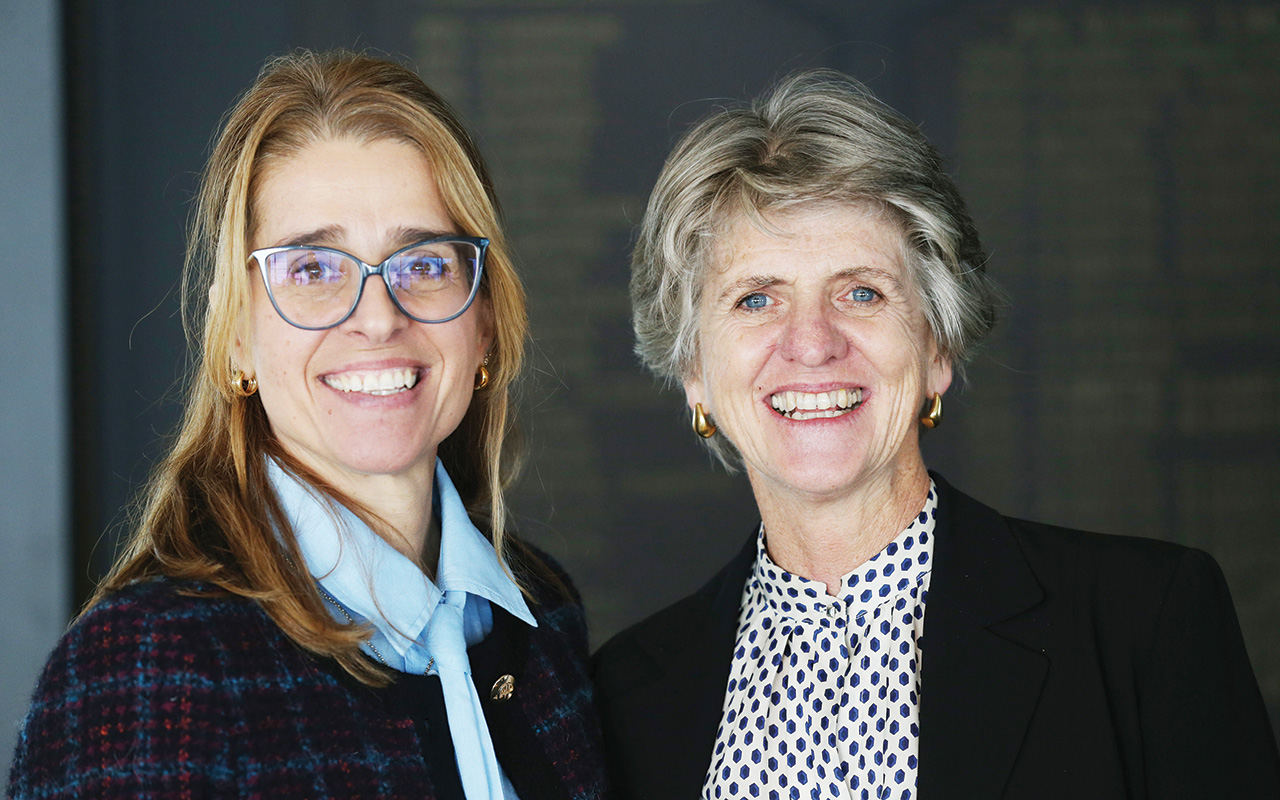
WHEN Tina Coumbe, principal of Crib Point Primary School, visited her local kindergarten to meet incoming students, she came back concerned. A number of children had such limited oral language that she simply couldn’t understand them. If she couldn’t understand them, how was anyone going to teach them to read?
That sense of alarm, and a phone call to the Mornington Peninsula Foundation (MPF), set in motion a literacy overhaul that would eventually encompass 10 peninsula schools, and outpace state government policy by three years.
“It found us in a way,” said MPF CEO, Stephanie Exton, of the foundation’s unexpected path into education.
Founded in 2017 by Ian Hicks AO with a straightforward question – “How come we have so much poverty in a place of such abundance?” – MPF had started by supporting housing, homelessness and family support services. But tracing disadvantage upstream kept leading to the same place: children who couldn’t read.
The cause, Exton said, was a shift in teaching methodology dating to the 1970s. Explicit phonics instruction (breaking words into component sounds) had given way to what became known as “whole language learning”, a philosophy built on the belief that children immersed in good literature would absorb reading naturally.
“It was a very romanticised view,” said Exton.
“If you had lots of cosy beanbags for them to sit on and they had half an hour reading every day, they would just learn it, because it’s so wonderful.”
The approach had no evidence base. Over 50 years its effects compounded – communities where parents couldn’t read raised children who couldn’t read, who left school without qualifications, struggled to find work, and raised the next generation in the same conditions.
MPF’s first intervention was a speech therapy trial at Crib Point Primary in 2018, and the results were immediate. Coumbe described the change in her student data as moving from “a sea of red to a sea of green”, Exton said.
Off the back of that success, MPF raised $1m to expand the program across five primary schools and their feeder preschools, bringing speech therapists into prep classes and kindergartens across the cluster.
The speech therapists brought something the teachers hadn’t been exposed to: a clinical, evidence-based approach to language acquisition that made the absence of evidence in reading instruction obvious.
Coumbe and Emma Slater, principal of Tyabb Railway Station Primary School, began digging into the research on phonics and sharing what they found across the cluster. So compelling was the evidence that by 2022, with MPF funding teacher training in the new methodology, the schools were pressing ahead before the curriculum had officially caught up.
“They were doing it in secret,” said Exton.
“They were literally not telling their superiors what they were doing.”
In 2024, the Victorian Minister for Education mandated the phonics-based approach for all state schools – vindicating what the cluster had been doing for three years.
The work looks different at each school level. In the early years, the focus has been on systematic phonics instruction, with Prep-to-Year-Two teaching now largely embedded across the cluster. At secondary level the challenge has been catching up students who missed foundational instruction entirely, with some entering Year Seven reading at Year Two level.
“We had less than 50% of children going to Year Seven at one of our secondaries would actually finish Year 12,” said Exton.
“Now 95% are completing Year 12.”
Underpinning it all is a model of schools actively supporting each other. MPF funds a primary schools improvement coordinator who moves between schools, linking principals, facilitating classroom visits and supporting implementation.
“A principal here goes to meet a principal there, or they go to look at the classes there, or the teachers go from this school to that school,” said Exton.
“It’s very much within the system that the changes are now happening.”
That connected, low-hierarchy approach is, Exton said, precisely what philanthropic funding makes possible. Government systems are not built for the kind of experimentation and peer-to-peer learning the cluster depends on.
“We can create the conditions for the change to be driven by the people themselves,” she said.
“It’s not like bringing in a program.”
More schools are approaching MPF to join the cluster, and the model has become more streamlined as established schools take on a coaching role with newer ones. The foundation estimates another four to five years of support is needed to catch up students who missed out on foundational phonics instruction.
“If this can catalyse a change which then perpetuates itself and our job’s done, that’s great,” said Exton.
“We don’t want to be anything more than is necessary at this moment.”
First published in the Mornington News – 7 July 2026
