


By Melissa McCullough
A DemosAU* poll taken between 30 October and 5 November has predicted a Liberal/Nationals win on Saturday with two-party preferred votes split 56 to 44 in the Coalition’s favour.
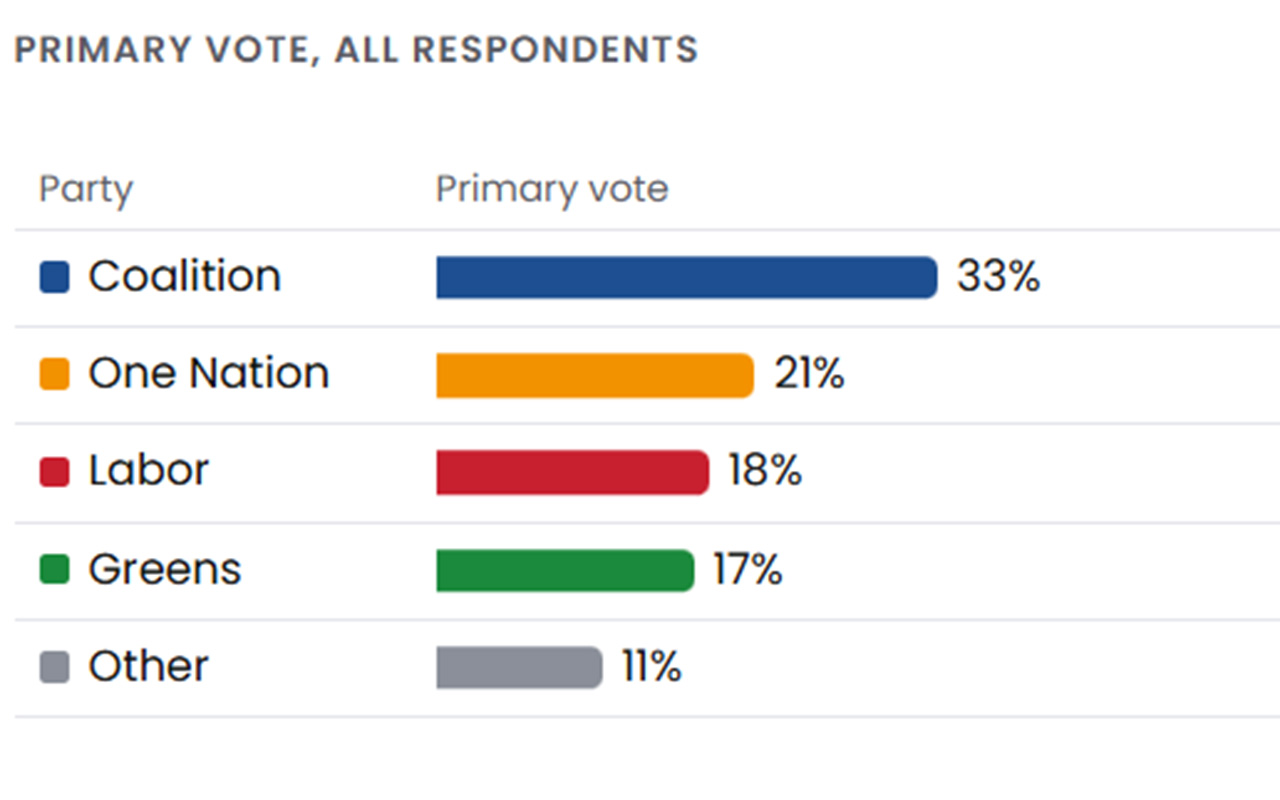
In terms of the primary voting intention of those polled, the Coalition fared the highest with 33 per cent of the respondents saying they’d be putting Liberals first.
That figure is down 1.5 per cent since the 2022 election, but up three per cent since September.
Labor’s primary vote has collapsed to just 18 per cent, down 18.7 per cent since the 2022 poll, and seven per cent down since September.
One Nation is the big mover, being virtually non-existent on the state stage in 2022, they now command 20.7 per cent of the primary votes of those polled. That figure is up one per cent since September.
Another considerable mover is the Greens, who are polling 17 per cent of the primary vote of those polled, up 5.5 per cent since 2022, and three per cent up since September.
Asked who their preferred Premier was between Jess Wilson and Ben Carroll, 48 per cent said Wilson, 30 per cent said Carroll and 22 per cent said they didn’t know.
Add Warren Pickering, One Nation’s Victorian leader into the mix, and the preferred Premier numbers for Wilson and Carroll drop to 36 per cent and 28 per cent respectively, with Wilson still holding a handy lead over the current Premier.
Pickering comes in at 19 per cent with the balance undecided.
Asked what their opinion was of the potential Premiers, only 17 per cent had a positive opinion of Carroll, down a massive 16 per cent since September.
In terms of a negative opinion of the current Premier, that figure stood at 47 per cent. The balance were undecided.
For Wilson, 38 per cent had a positive opinion, up five per cent since September, while 25 per cent had a negative opinion.
As for Pickering, 20 per cent had a positive opinion of One Nation’s Victorian leader, down two per cent since September, while 43 per cent had a negative opinion, only four per cent behind Carroll in the negative ratings.
And for Greens leader Ellen Sandell, 18 per cent had a positive opinion of her, down five per cent since September, while 38 per cent had a negative opinion, and the balance undecided.
When it comes to age groups, while only 17 per cent had a positive opinion of Carroll, it rose to 23 per cent in the 18-34 demographic before trailing off in the older demographics.
For Wilson, whose positive opinion stood at 38 per cent, popularity in that lowest age bracket was her lowest, at 28 per cent.
It then rose to 30 per cent in the 35–54 age bracket before soaring to 52 per cent positive opinion in the oldest 55+ demographic.
As for Pickering, with 20 per cent overall positive opinion, he too struggled with the younger demographic.
Just 16 per cent of the 18–34 age group had a positive opinion of him as leader, growing to 25 per cent of the 35-54 demographic and to 27 per cent of the 55+ demographic.
The Greens leader, Sandell, with an overall positive opinion sitting at 18 per cent, got most of her support from the youngest demographic with an impressive 32 per cent of 18-34 year olds holding a positive opinion of her.
That figure drops quickly to 21 per cent of those in the 35-54 age group, and then to a low seven per cent of the 55+ demographic.
In terms of the biggest issue facing Victoria today, those polled said the number one issue was cost of living and household finances (41 per cent).
That issue affected those in the 35-54 age bracket the most with 51 per cent in that bracket putting cost of living as their biggest issue, with that trailing off to just 31 per cent putting it as their biggest issue in the over 55 bracket.
Cost of living and household finances was followed by crime and community safety (26 per cent) and state debt, budget and spending (11 per cent).
Further down the list of issues facing Victoria today were housing and homelessness (eight per cent), government leadership and integrity (seven per cent), roads, transport and infrastructure (six per cent), immigration and population (five per cent), economy, jobs and business (four per cent), climate, environment and water (three per cent), health, disability and care (two per cent), taxes and charges (two per cent), social issues, rights and discrimination (one per cent), and education (one per cent).
* Source: DemosAU Victorian poll, (5 November 2026).
First published in the Mornington News – 24 November 2026
