

Close Menu
  • Home
  • News
  • Sport
  • Entertainment
  • Local Lives & Landmarks
  • Contact Us
  • Advertise With Us
  • About Us
  • Subscribe
  • Read Our Newspapers Online
    • Read the Latest Western Port News
    • Read the Latest Mornington News
    • Read the Latest Southern Peninsula News
    • Read the Latest Frankston Times
    • Read the Latest Chelsea Mordialloc Mentone News
  • Competition
  • Home New
Facebook X (Twitter) Instagram
Monday, April 6
Facebook X (Twitter)
MPNEWSMPNEWS
  • Home
  • News
  • Sport
  • Entertainment
  • Local Lives & Landmarks
  • Contact Us
  • Advertise With Us
  • About Us
  • Subscribe
Breaking News
MPNEWSMPNEWS
Home»News»Beware when bluebottles sail to shore
News

Beware when bluebottles sail to shore

By MP News GroupDecember 12, 2016Updated:December 19, 2016No Comments2 Mins Read
Facebook Twitter LinkedIn Reddit Threads Email Copy Link
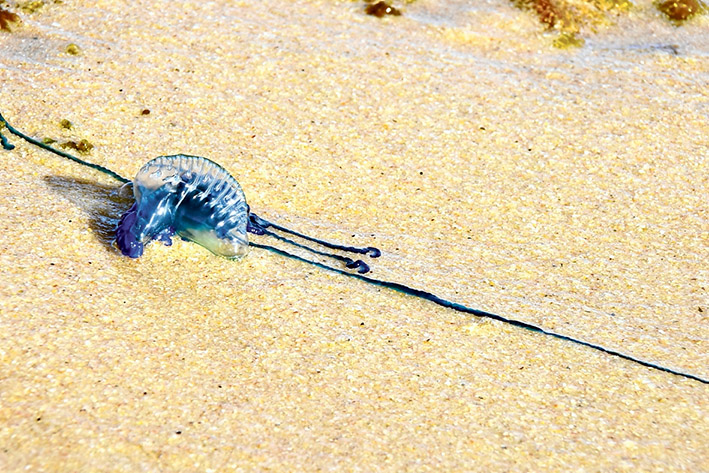
Washed up: A bluebottle on Mt Martha beach. They are becoming common all over bay and ocean beaches. Picture: George Russell
Share
Facebook Twitter LinkedIn Pinterest Email
Washed up: A bluebottle on Mt Martha beach. They are becoming common all over bay and ocean beaches.            Picture: George Russell
Washed up: A bluebottle on Mt Martha beach. They are becoming common all over bay and ocean beaches. Picture: George Russell

VISITORS to the peninsula’s bay and ocean beaches may have noticed the prevalence of bluebottle jellyfish.

The common bluebottle, Physalia utriculus, is smaller and less venomous than its Atlantic cousin Physalia physalis – or Portuguese man o’war – but it can still produce a painful sting.

While they may look like a single marine creature they are actually colonial organisms known as siphonophores, with separate animals specialised for food capture, digestion, reproduction, and one that makes up the gas-filled float. The animals cannot function alone and the whole can only survive as a colony.

The floats can grow up to 150mm long and tentacles to more than a metre.

An intriguing feature is that half the colonies have floats aligned at 45 degrees to the right of the wind and half at 45 degrees to the left. It is surmised that this anatomical difference aids the survival of the species by ensuring only half of the colonies will face being marooned along the coast in the prevailing wind.

The animals capture fish and small marine creatures by dragging their tentacles through the water and stinging and killing their prey.

The powerful stinging cells, called nematocysts, line the tentacles and inject venomous neuro and muscle toxins, immobilising and killing their prey with rapid efficiency.

When swimming or walking near the shoreline keep an eye out for them but don’t get too close. The sting is quite painful but it generally subsides in about half an hour.

If stung, Surf Life Saving Australia recommends carefully removing any remaining tentacles and soaking the area in hot water or covering with ice packs. Do not scratch or rub the sting site.

Often accompanying each armada are other floating marine creatures, such as by-the-wind-sailor, velella velella, porpita sailors, porpita porpita, and other species of blue drifting invertebrates.

George Russell

First published in the Mornington News – 13 December 2016

Related Posts

Play halted at Red Hill South playground

April 4, 2026

Victorians missing out on container cash

April 3, 2026

Witnesses sought after hit-run on Mornington Peninsula Freeway

April 2, 2026

Lighting the Way

April 2, 2026
Add A Comment

Comments are closed.

Peninsula Essence Magazine – Click to Read
Peninsula Kids Magazine – Click to Read
Letters to the Editor
Property of the Week

47A Strachans Road, Mornington

Property Of The Week January 27, 2026
Council Watch

Marsh takes leave from council duties

February 25, 2026

Council to consider rate relief for landslide homes

December 23, 2025
100 Years Ago This Week

Mornington – Where the billy no longer boils

April 2, 2026
Menu
  • Home
  • News
  • Sport
  • Entertainment
  • Local Lives & Landmarks
  • Contact Us
  • Advertise With Us
  • About Us
  • Subscribe
About

Established in 2006, Mornington Peninsula News Group (MPNG) is a locally owned and operated, independent media company.

MPNG publishes five weekly community newspapers: the Western Port News, Mornington News, Southern Peninsula News, Frankston Times and Chelsea Mordialloc Mentone News.

MPNG also publishes two glossy magazines: Peninsula Essence and Peninsula Kids.

Facebook X (Twitter)
© 2026 Mornington Peninsula News Group.

Type above and press Enter to search. Press Esc to cancel.