

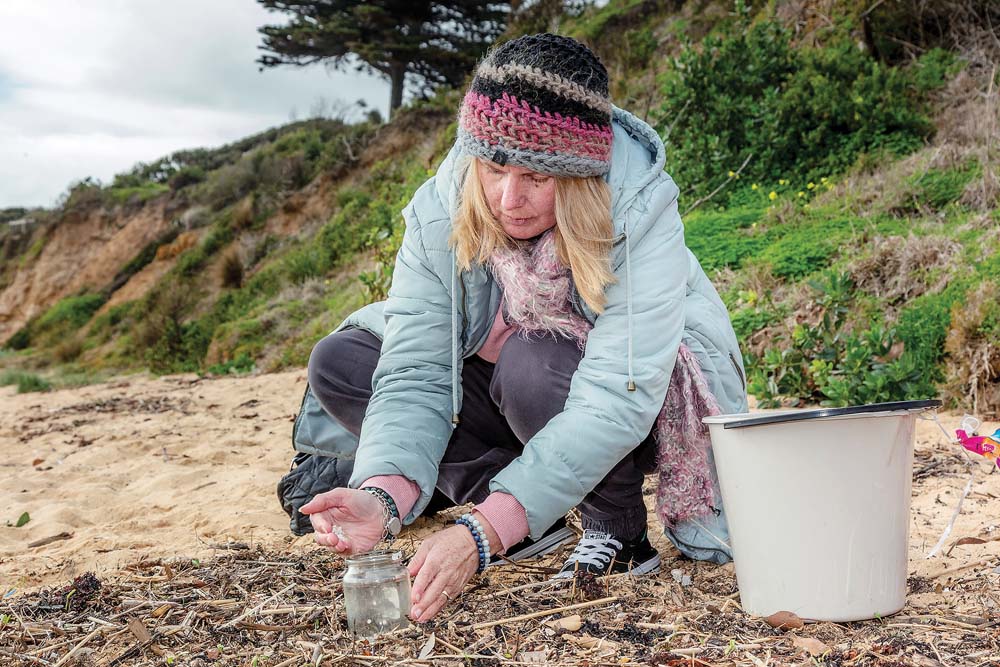
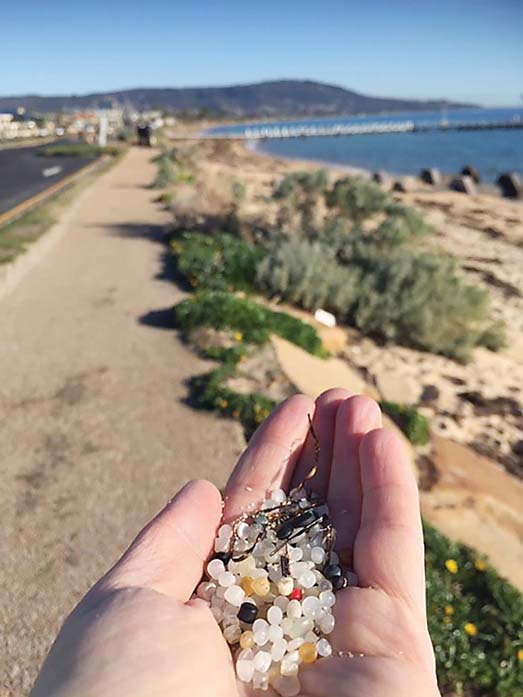
 A ST ANDREWS’ woman is on a mission to rid the beaches of tiny plastic waste particles called nurdles.
Lyn Wedd said the minute pellets were washing down drains, over the beaches of Port Phillip and through the Heads and around to St Andrews ocean beach, near Rye.
She wants to inspire the possibly uninformed plastics manufacturers and handlers of the nurdles to “clean up their act”.
“To date, they’ve been getting away with it but, hopefully, new legislation will make them more accountable,” she said last week while cleaning a section of Mt Eliza’s foreshore at Canadian Bay.
“We need legislation to stop nurdles. They’d fine me if I threw a water bottle into the sea, but plastics manufacturers can wash the raw pellets down drains and nothing happens to them.
“And this is despite plastic being listed as a threat to our waterways in the state government’s environment protection policy.”
Ms Wedd had a “lightbulb moment” five years ago when resting on the sand at a Mt Eliza beach.
“The sun was shining on these gleaming little particles, which I initially thought were jewels,” she said.
“I scooped up a handful and realised they were plastic.”
The pollutants are now five years further into their march to colonise the environment – with experts claiming plastic particles have entered every part of our food chain and even our bodies.
A recent European study found the highest plastic concentrations in animals were in the gut, with the smallest micro-plastic particles capable of entering our blood streams, lymphatic systems and even our livers.
When Ms Wedd chanced on nurdle concentrations at St Andrews beach she contacted Port Phillip Baykeeper Neil Blake who exclaimed: “Please don’t tell me they are at your beach? That means they have escaped Port Phillip. It’s getting worse and worse.”
When Ms Wedd visited Phillip Island with her surfer husband Brendan she found similar concentrations there. “The beach was littered with them,” she said.
“I thought: ‘That’s it, we must get [state government] legislation to get rid of them.”
EPA southern metropolitan region environment protection officer Erin Carmelito said the plastic pellets were defined as “waste” under the Environment Protection Act 1970 which “must be managed appropriately”.
“Plastics manufacturers do, in fact, have the same obligations under the act as all commercial and industrial business,” she said.
“The EPA requires businesses that produce, transport or use nurdles to keep them contained and under control; away from water and wind; and away from stormwater drains.”
Pellets not properly managed and discharged into the environment can lead to charges of illegal dumping of industrial waste or creating an environmental hazard.
New laws coming into effect on 1 July 2020 will give the EPA powers to require businesses to act before pollution occurs, rather than addressing harm after the fact, Ms Carmelito said.
They must have measures in place to prevent waste being discharged, such as waste management plans, training, equipment maintenance, and spill capture and response.
To report the washing waste of any sort into stormwater drains email the EPA or call 1300 372 842.
First published in the Southern Peninsula News – 16 July 2019
