

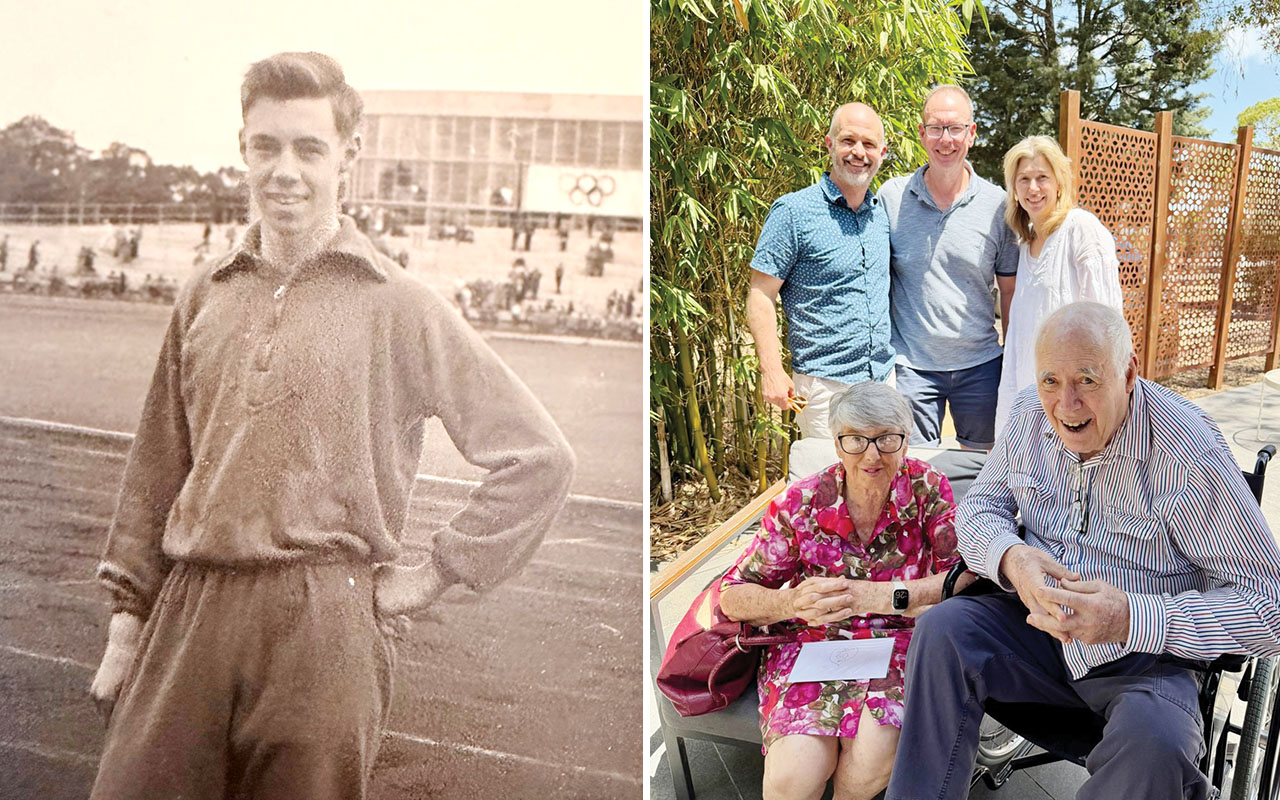
DAVID Evan Price was born on 21 October 1940 to Eric Evan Price and Marcelle Whittaker, and grew up alongside his younger siblings Jocelyn, Ian and Andrew.
He began his schooling at Little St Margaret’s Kindergarten. David went on to Scotch College, where he thrived.
Sport was a huge part of his school life and he gained Colours in football, cricket and athletics. One of his favourite photos was that of the Under 12A cricket team which had himself as captain and a young man named Bob Cowper as one of his assistants.
Bob went on to make a triple century at the MCG which is still the highest ever score by an Australian in a test match there, but David was once his captain. This was something he pointed out pretty much every time the family went to the MCG to watch the cricket or his beloved Bombers and saw the huge Cowper sign hanging above the members bar.
David was also very proud of playing football and scoring a goal on the MCG in the famous Scotch College versus Melbourne Grammar match of 1958 to commemorate 100 years since the first recorded Australian Rules football match.
School life wasn’t only about sport. David was deeply influenced by the Crusader Movement which helped nurture and strengthen his Christian faith — a faith that would shape the rest of his life. He was leader of the Crusaders in his last year of school.
His leadership qualities were already evident in other areas as well. He loved the cadets and eventually became Head of the Cadet Guard, even taking part in the Guard of Honour for the Queen in 1954. Though he wore the kilt and sporran with pride, he loved music enough that he never played the bagpipes. Although he was a proud member of the school choir.
In 1958, David’s leadership culminated in his appointment as Captain of the School. An excerpt from the yearbook reads “Throughout the school Dave has shown his great ability as a leader and it was indeed fortunate for the school that there was such a boy to be captain in 1958. He has worked always for the good of the school and his influence will be felt long after he has left it.”
Those sentiments held true for the rest of his life.
And despite all that he did fit in some study, where he was dux of Greek history, something that became important later on.
At university he continued his love of sport, playing with the Uni Blues, where the team won a premiership. That team still meets up to this day — a testament to the friendships formed. He was also awarded a Best and Fairest one season and made the Victorian team for the amateur association.
At Uni he was also deeply involved in the Evangelical Union, where he ended up becoming President in his final year. His willingness to volunteer for leadership positions continued.
After graduating, David began the long road toward becoming a surgeon. He worked at Footscray Hospital, Alfred, Melbourne University Anatomy School, PANCH, and the Austin while studying for his surgical qualifications. It was a demanding time, but David managed it somehow, having to balance it with all his other growing interests with a growing young family.
During these years, camps through the Crusaders movement took him to places like Tasmania, Coolamatong, and Wilsons Promontory and Toolangi. These camps were significant not only for faith and friendship — but also because they helped bring him closer to the woman who would become the love of his life.
David met Nancy at university, but it was through CSSM at Barwon Heads — sometimes jokingly called “Come Single, Soon Married” — that they really got to know each other. In this case, the nickname proved accurate.
They married on Thursday, 13 January 1966. Their family soon followed, with Michael born in 1968, Louise in 1970, and later Richard in 1973 while the family was living in England. David’s last outing was on Australia Day to a local winery where he and Nancy celebrated their 60th wedding anniversary with their children and grandchildren – and some cards of congratulations from the King, Prime Minister and Governor General.
In 1971, David and Nancy embarked on a wonderfully adventurous journey to England, in search of what he described as “cutting experience”. For although he had finally qualified as a fellow of the royal college of surgeons, being dux of Greek history had not been of great assistance when looking for his first surgical job. So he headed off to England where he had heard that the National Health Service was happy to hire young Australians to practise their surgery on English folk who had no say in their choice of surgeon.
David inherited a love of travel from his mother, so his journey to London was not going to be straightforward. He managed to get a free ticket for himself to Rome by agreeing to escort a schizophrenic immigrant being repatriated. He also transferred his savings to an Italian bank so he could purchase a car when he arrived and have a European tour before arriving in the UK. Unfortunately when he got to Rome he had no recollection of which of the 30 branches of that bank he had transferred the money to and was unable to retrieve the money. But David wasn’t going to let this spoil his plan, so David and Nancy and two little ones flew to Pisa, Florence, Venice, Vienna, Budapest, Zurich and Geneva before running out of traveller cheques and finally arriving in London.
Over the next few days he had a series of job interviews, but Nancy clearly recalls that after leaving the first one, David spotted a bus that said it was going to Wimbledon. So he got on the bus, went to the tennis, and returned home eight hours later. He was never one to miss an opportunity.
After several short term positions in London, he accepted an appointment at Worthing and Shoreham Hospitals, where son Richard was born. During this time in Sussex the family also developed a lifelong connection to Brighton and Hove Albion Football Club.
In 1974, David’s sense of calling led him to volunteer with the Overseas Missionary Fellowship in Manoram in central Thailand. It was a transformative experience. David loved the Thai people, learned the language, and formed friendships that lasted a lifetime.
This experience sparked a lifelong commitment to overseas medical volunteer work. Over the years he returned to Thailand several times and also served in Nazareth, Kathmandu, Russia on the River Ob, and East Timor. There were challenges along the way — hepatitis in Thailand that left him unable to work for two months, and even a spider bite in Russia that sidelined him — but these never diminished his enthusiasm.
In 1975, the family returned to Australia, settling in Mornington after David was invited by Dr Charles Hopkins to take a temporary position in his general practice before eventually securing a surgical appointment at Frankston Hospital. He later also worked in Leongatha and at Beleura Hospital on the Mornington Peninsula.
For David, coming to Mornington felt like coming home. His grandparents had owned a holiday house there since the 1920s, and he had many fond memories of fishing for flounder with his father.
David’s life in Mornington was extraordinary for the breadth of his involvement. His passion for social justice was immense. He worked with the St Mark’s Interchurch Social Justice Group, the Aboriginal Awareness Group, the Regional Council for the Leprosy Mission, and he regularly joined peace marches.
He volunteered widely — on the Mornington High School Council, the Bentons Square Community Centre, the Mornington Historical Society and he chaired the Friends of Los Palos committee for many years, and many church and community committees. In fact, as the council member living closest to the community centre, he was the one responsible for responding whenever the alarm went off.
David was also deeply involved with Fusion, the Interchurch Council, and helped establish the Mornington Community Contact House. He served as patron of Friends of Vellore Victoria, supporting the Christian hospital in South India. David joined the committee much earlier, in the late 1960s, and showed such loyalty and commitment to this Christian hospital in South India for his adult life and was honoured to be made Patron in the last few years.
His love of sport never left him. He served as interim team doctor for the Mornington Football Club, but when his sons showed talent for soccer he became president of the Mornington Soccer Club — the Seagulls.
At the same time, he maintained a demanding career as a general surgeon, including 24-hour on-call duties.
But the heart of David’s life was always his Christian faith. Nurtured by his mother and by the Toorak Presbyterian Church, he became an Elder in the Presbyterian Church in the late 1960s — a role he regarded as a lifelong calling.
David was deeply ecumenical. He loved bringing churches together, organising Bible studies during Lent, and welcoming conversations across denominations. When Jehovah’s Witnesses knocked on the door he wasn’t interested in arguing — he simply wanted to talk about what they agreed on.
He taught Religious Education at Vale Street for many years and served on the Council for Christian Education in Schools, as well as the Scripture Union Council. He worked hard to get Chaplains into local schools; a cause he was very passionate about.
For his enormous service to the community, David was awarded the Medal of the Order of Australia (OAM) — an honour he was extremely proud of.
Outside work and church, David had a zest for life. He loved the outdoors, completing walks at Wilsons Promontory, Mount Buffalo, the Overland Track, and even trekking to Annapurna Base Camp.
His political views were strong, but also wide-ranging. Over the years he supported candidates from many different parties — Liberal, Labor, Democrats, Greens and independents. For David, ideas mattered more than labels.
He also had a deep love of music. He held a long-time subscription to the Melbourne Symphony Orchestra, proudly keeping the same seats his grandmother had once held because of her involvement in the orchestra’s early days.
With his Welsh heritage David had a great voice and loved singing with many choirs — from Toorak Presbyterian, to the University Choral Society, the Peninsula Chorale, St Mark’s Music Group, and even the Bentons Lodge Choir. One of the highlights was performing in Carnegie Hall, where he met composer Karl Jenkins.
Music also inspired some of David’s more adventurous ideas. For years he organised Carols on a Truck, tying chairs to to the back of a semi-trailer and driving around singing to nursing homes and people shut in at Christmas — throwing oranges to residents along the way. When health and safety regulations eventually stopped the truck, David simply started Carols at Farrells Bookshop, gathering singers from across the community.
In the last two years of his life, David became a resident at Bentons Lodge, where he found great happiness. He loved the multicultural community of staff and residents, enthusiastically joining quizzes, church services, exercise classes and — of course — committees. He even ran successfully on a platform to add milkshakes to the menu.
He was honoured to become an honorary member of the Mount Martha Rotary Club and to receive a Paul Harris Fellowship, reflecting a motto that perfectly captured David’s life: Service Above Self.
Not everyone always agreed with all of David’s views — and he probably wouldn’t have wanted them to. But no one could ever doubt his passion, his courage, his curiosity, or his commitment to making the world a better place.
David lived with optimism. He truly believed in the kindness of strangers and in the idea that, somehow, things would work out.
And more often than not, they did.
His was a life full of service, adventure, faith, music, friendship, and family.
First published in the Mornington News – 31 March 2026
