


By Melissa McCullough
POLLING released by Roy Morgan at the end of October showed some significant movement in voting intentions during the month.
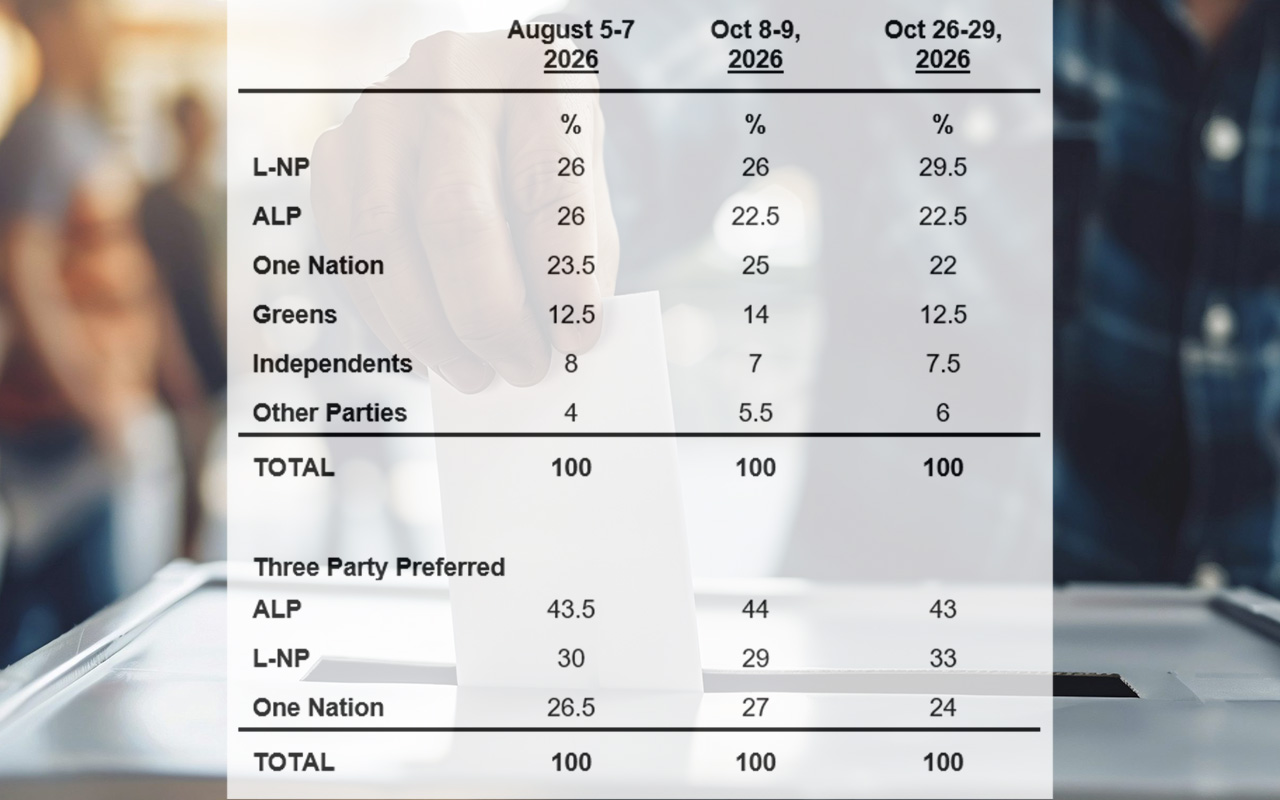
The figures released on 30 October compared voting intentions as polled from 8-9 October and showed the Coalition opening up a significant lead.
During those three weeks, the Liberal/National Coalition rose 3.5 per cent, to 29.5 per cent of the primary vote, widening their lead over the ALP which was unchanged at 22.5 per cent.
One Nation had softened during the period by 3 per cent down to 22 per cent.
According to the poll, the L-NP Coalition now has a significant lead over Labor on a two-party preferred basis: L-NP 56 per cent (up 1 per cent from October 8-9, 2026) compared to ALP 44 per cent (down 1 per cent).
Analysis by Roy Morgan stated, “If a Victorian state election were held now the L-NP would be favoured to form government, and likely with a majority of seats. However, winning a majority of seats is not certain for the L-NP given the highly contested nature of many seats – especially in rural and regional Victoria, and outer suburban Melbourne.”
While the two-party-preferred vote between Liberal and Labor favours Liberals by 12 per cent, when the numbers are run for two-party-preferred between Liberal and One Nation, the Coalition is even further ahead. The L-NP are sitting at 74 per cent (up 3 per cent) and One Nation are at 29 per cent (down 3 per cent).
The polling states the L-NP’s large lead over One Nation is due to the preferences of ALP voters heavily favouring the L-NP Coalition over One Nation.
In the scenario of a two-party-preferred contest between the ALP and One Nation, the ALP are at 54.5 per cent (up 0.5 per cent), and are holding a clear lead over One Nation on 45.5 per cent (down 0.5 per cent).
“Support for One Nation increased in early October after they launched their campaign in Melbourne on Saturday October 3, but over the last three weeks One Nation has fallen back to where it was prior to their campaign launch,” said the Roy Morgan analysis.
“Importantly a three-party preferred result shows the ALP is still in a strong position to progress to the final two-party preferred contest due to the strong flow of preferences to the ALP from the supporters of the Greens, Other Parties, and Independent, candidates.
“Although the ALP performs well on a three-party preferred result, the flow of preferences from One Nation to the L-NP Coalition means the L-NP Coalition clearly overtakes the ALP on a two-party preferred basis.”
First published in the Mornington News – 17 November 2026
