

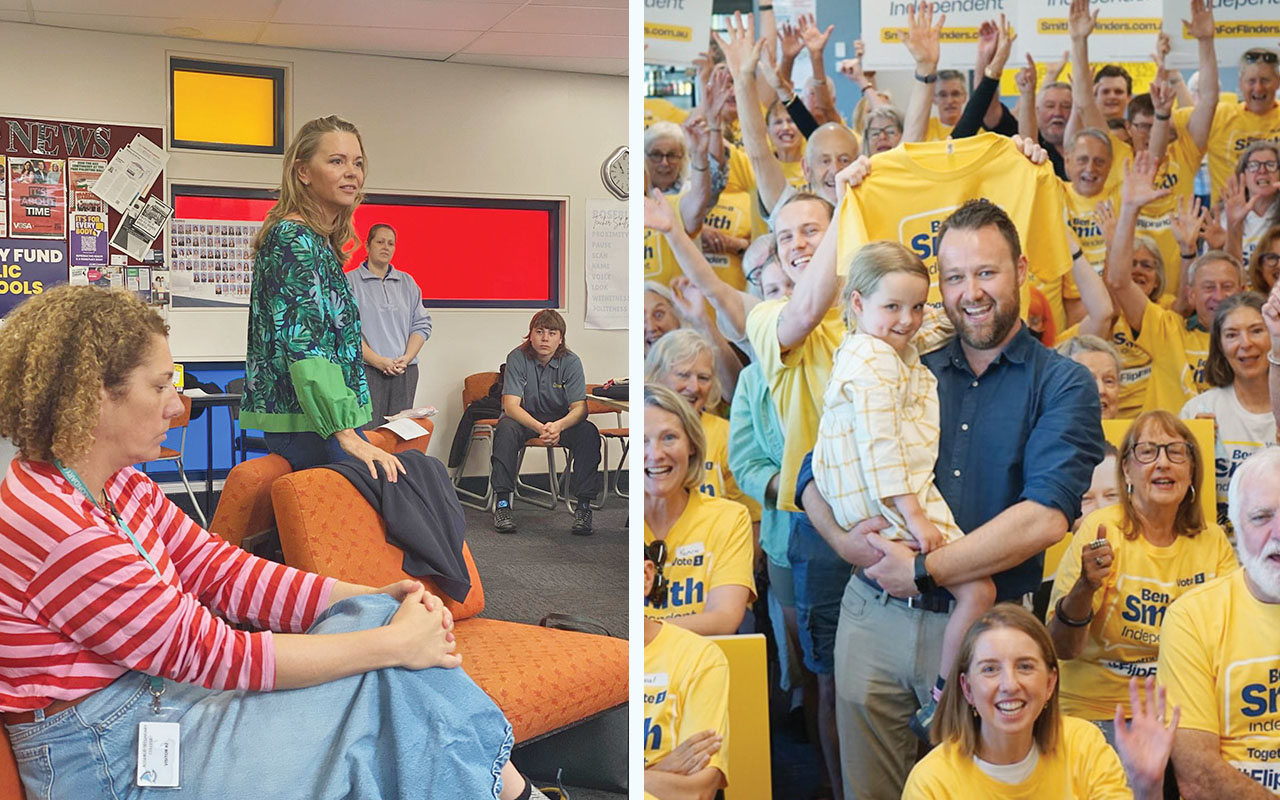
THE Australian Electoral Commission has released data on the battle for the seat of Flinders, showing substantial donations and expenditure for the Ben Smith campaign, but “zero” returns from Labor and the Liberal Party.
Under the AEC rules, the “Transparency Register” does not include the candidates from registered political parties who “may submit a ‘nil return’ and roll their reporting into the annual return for their party if those financial transactions were the responsibility of a party committee”.
That data is due to be released on 2 February 2026 but will only provide donation and expenditure for those parties overall and not split into electorates.
The effect of the AEC’s approach is that while Smith discloses, the data released on Monday by both Labor’s Sarah Race and the Liberal Party’s Zoe McKenzie had “zero” donations and “zero” expenditure.
Smith, on the other hand, disclosed the receipt of $1,786,645 in the form of donations from a total of 641 donors, and election expenditure of $1,712,798. The largest single donor to the Smith campaign was Climate 200 with donations totalling $1,024,700.
The eventual winner of the seat of Flinders, Zoe McKenzie, took to social media on Tuesday (21 October) stating “We need to have a conversation about honesty, integrity and the Teals”.
“Yesterday, the Australian Electoral Commission revealed that Ben Smith was the second highest Climate 200 funded candidate in the entire country.”
Pointing out that Climate 200 and a number of other substantial Smith donors were Sydney based, McKenzie continued “Through conniving, deceiving and dodgy dealing over preferences, the ‘blow ins’ tried to use their big bucks to buy Flinders”.
Despite consistent efforts by McKenzie and others to frame Smith as a member of a “Teal” party, being in a party would have placed Smith in the same category as McKenzie; not having to disclose individual donations and expenditure at an electorate level.
Jason Smart, who began his campaign as a Trumpet of Patriots candidate before breaking away from the Palmer party over a disagreement regarding preferences, told The News that he believed that everyone should disclose.
“It is pretty simple. Everyone should disclose what donations they received, and from where. This is the only way to prove that candidates and political parties have nothing to hide.”
Smart said he holds this opinion even though much of his expenditure was not disclosed due to being a party candidate with Trumpet of Patriots for an extensive amount of his campaign.
“After I broke away from Trumpet of Patriots and Clive Palmer, I returned all campaign materials including the chairs, umbrellas and eskys unused and unopened. After that I funded my own corflutes, fliers and a sausage sizzle at my own expense.”
Independent candidate Joseph Toscano received no donations and self-funded his $8250 in expenditure. “The reality is you need to spend over a million dollars if you are an independent wanting to take on a major party candidate. It is a sad reflection on our current politics, but it is the reality,” said Toscano.
Mike Brown, who ran as a candidate for One Nation, confirmed he received no donations, and self-funded the entirety of his campaign to the value of $5250. “I wasn’t in it for the money, nor did I want to be obligated to contributors. I believe in putting Australia and Australians first,” he said.
The News reached out to both the Liberal McKenzie and Labor’s Race, asking if they would like to provide information on their donations and expenditure during the election campaign.
While not providing the requested information, Race provided the following statement: “I ran a local grass roots community campaign for Flinders. We raised a modest amount from local members and I’m very proud of what we could achieve up against the eye-watering amount spent in other campaigns”.
McKenzie did not respond to The News’ request for information on donations and expenditure for her 2025 election campaign.
Smith told The News, “I’m incredibly proud of what we achieved. We came within just 2.3 per cent of winning in one of the safest Liberal seats in the country — and reduced their primary vote to its lowest level since World War Two.”
“I want to remind Mornington Peninsula voters that we turned a safe Liberal seat into a marginal one. That matters. A safe Liberal seat does not serve us — the Liberals don’t spend in Flinders because they think they can’t lose it, and Labor don’t spend here because they think they can’t win it. Whereas marginal seats attract funding — sometimes hundreds of millions of dollars.”
“Hopefully now the major parties will no longer take Flinders for granted. If this shift means we start to get our fair share of investment in local roads, schools, hospitals and infrastructure, it will dwarf whatever I spent on the campaign — and deliver real, lasting benefits for the people of the peninsula.”
First published in the Mornington News – 28 October 2025
