

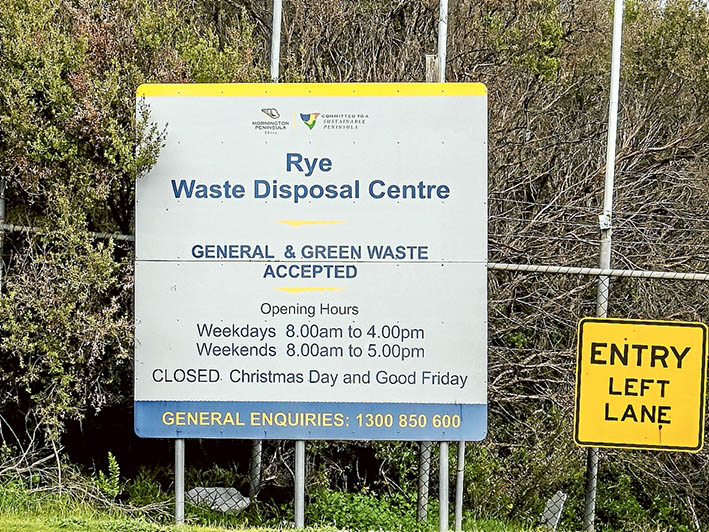
MORNINGTON Peninsula Shire has approved expenditure of up to $32.75m, including GST, to manage the peninsula’s residual waste after the Rye Landfill reaches capacity later this year.
At the 11 August council meeting, councillors unanimously voted to endorse the total forecast expenditure under the Department of Energy, Environment and Climate Action (DEECA) landfill contract.
The shire opted into the contract in October 2025, and it is set to expire on 31 March 2027.
A further two-year extension is available, with the decision to execute the extension now delegated to the Chief Executive Officer.
Under the arrangement, residual waste will be transported to a transfer station in Dandenong before being bulk hauled to a disposal facility.
Cr Paul Pingiaro, who moved the motion, said the reality before council is straightforward.
“The current landfill cell in Rye is reaching the end of its capacity,” said Pingiaro.
“Once that current cell is full, our residents will still generate around about 35,000 tonnes of residual waste every year, and that waste needs another home.”
Pingiaro said this DEECA arrangement provides council with a pathway, allowing them to find another home for the peninsula’s residual waste while maintaining curbside service.
“I see this contract as a bridge, not the destination,” said Pingiaro.
“It answers the immediate question of where our residual waste goes once the current cell at Rye reaches capacity. It does not answer the more important long-term question of what the Mornington Peninsula’s waste system should look like in ten, or 20, or 30 years.”
Pingiaro said every tonne of waste that can be avoided, recycled, or repurposed increasingly helps the environment and the shire’s financial value.
“I do think we should keep an open mind about the full options available to us,” said Pingiaro.
“Existing infrastructure, emerging technologies, greater resource recovery, partnerships and whatever other opportunities present themselves in this changing sector.”
Cr Michael Stephens said he supports the proposal despite the additional cost to council regarding transport.
“This option adds additional cost to council in terms of transporting approximately 35,000 tonnes of waste to Dandenong, as well as increased transport emissions,” said Stephens.
“Our choices at the moment are very limited on what we can do.”
Stephens said a waste transfer facility on the peninsula could significantly reduce the number of truck trips taken.
“A local transfer station could potentially consolidate this waste into larger semi-trailers capacity carrying around 40 tonnes,” said Stephens.
“This could reduce the number of truck trips required from approximately 3,500 to 875 per year.”
Stephens said ratepayers can play a significant role in helping reduce the amount of waste that needs transporting.
“By actively reducing their own waste streams, composting organic waste at home, and taking full advantage of the green bins that will be provided to all properties on the peninsula,” said Stephens.
The Rye transfer station will continue to operate and be accessible to the public even after the closure of the current cell.
First published in the Southern Peninsula News – 19 August 2026
