

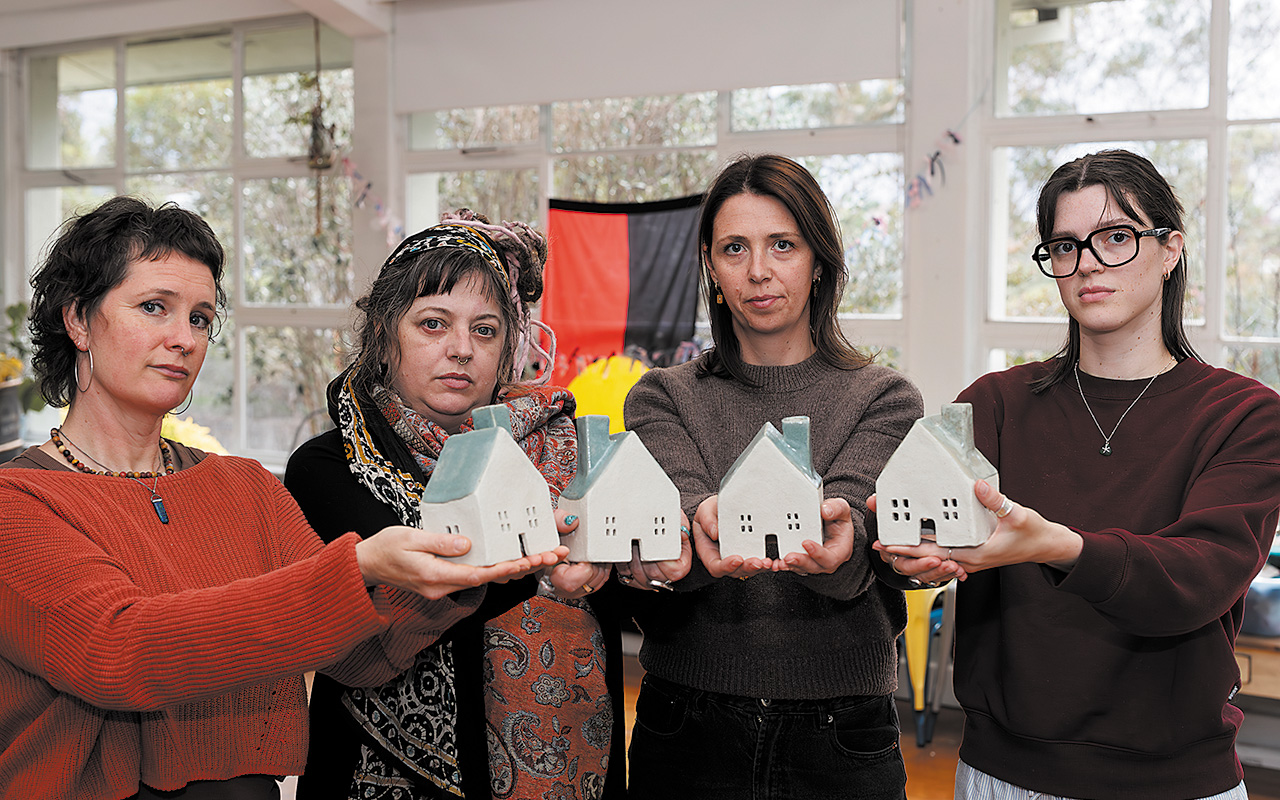
TWO Mornington Peninsula homelessness services have welcomed a $500,000 Liberal Party election pledge but say ongoing operational funding remains the more urgent need.
Liberal Candidate for Nepean Anthony Marsh announced on 30 April that an elected Liberal and Nationals government would provide $250,000 to Fusion Mornington Peninsula and $250,000 to Southern Peninsula Community Support (SPCS).
The funding is contingent on the Liberal-Nationals Coalition winning government at November’s state election. Marsh, the former Mornington Peninsula Shire mayor, won the Nepean seat at the 2 May by-election triggered by the February resignation of former member Sam Groth.
“This investment is about more than a roof, it’s about making sure vulnerable people, including young parents and those sleeping rough, get the support they need to rebuild their lives and secure a stable future,” said Marsh.
Shadow Minister for Housing David Southwick said the $500,000 investment would support both early intervention and frontline outreach.
Fusion has supported young people and families at risk of homelessness on the peninsula for 40 years.
Fusion Team Leader Gemma Hughes said the $250,000 would fund The Village, an expansion of the organisation’s youth housing program in Mt Martha designed to house young women and their children escaping family violence.
Hughes said Fusion was at full capacity, housing nine young people and two families at its Mt Martha property with three external properties also full, and families being accommodated in staff dwellings as a last resort.
“For every referral we receive, we are typically turning away five to seven young people,” said Hughes.
She said young people aged 10 to 19 were now the largest group seeking homelessness support locally, with family violence escalating since COVID-19 and the Airbnb boom hollowing out affordable rental stock.
“The cruel irony is that the peninsula’s image as a wealthy holiday destination has long made it invisible to government funding bodies,” said Hughes.
“It doesn’t fit the profile of a community in crisis – but it is one.”
Hughes said Fusion received no state government funding for its peninsula housing programs and had been lobbying for $250,000 in recurrent annual operational funding for more than two years.
She said the organisation had repeatedly contacted former Housing Minister Harriet Shing without response, and had recently made initial contact with new Minister for Housing Nick Staikos.
“If Minister Staikos allocates $250,000 as recurrent annual funding, the impact would be transformational,” said Hughes.
“It would allow us to house more young people, expand support for mothers and their children, and finally offer something this region currently does not have – a properly resourced, sustainable answer to youth homelessness on the peninsula.”
SPCS Chief Executive Jeremy Maxwell said the $250,000 pledge would help restructure his organisation’s three rough sleeper outreach programs – SPLASH (shower and laundry), SPLASH for Women, and Homeless Connections – and allow it to support more clients.
“We are now the largest area for rough sleeping in Victoria,” said Maxwell.
“We are overwhelmed.”
He said 144 rough sleepers had been officially recorded on the peninsula, but the true figure was conservatively two to three times that number.
Maxwell said people on the peninsula were three times more likely to become rough sleepers than elsewhere in Victoria, with most camping in foreshore bushes and parks, and older women and families sleeping in cars.
He said SPCS had only one dedicated outreach worker, with limited part-time support from two other staff members, and needed at least two more full-time equivalents to manage demand safely.
Maxwell said SPCS received no state government funding for homelessness services or emergency relief programs. In addition, he estimated almost $1m in federal emergency relief funding had been lost across the peninsula in the current tender, with SPCS, Mornington Community Support Centre and Western Port Community Support all affected.
He told The News the peninsula had the lowest per capita housing spend in greater Melbourne and Geelong, with the state government spending about $83 per head locally compared to around $3,000 per head in some inner-city local government areas.
“It’s like there’s a collective amnesia that we exist,” said Maxwell.
Maxwell said Capel Sound ranked in the top three per cent for disadvantage in Victoria according to Australian Bureau of Statistics data, but wealthy areas at either end of the shire masked the level of need.
The pledge does not include funding for Mornington Community Support Centre (MCSC), which runs the peninsula’s only crisis accommodation.
MCSC’s Chief Executive Officer, Ben Smith, said: “MCSC welcomes the election commitment of $500,000 to Fusion Mornington Peninsula and Southern Peninsula Community Support collectively, who like us are on the front line dealing with the homelessness crisis on the peninsula. This sort of commitment is overdue and whilst it relies on a Liberal Party victory in November, it represents a recognition of the urgent need for government support in our area.”
Smith said MCSC and the other peninsula service providers had been highlighting the issue with government for years.
“MCSC runs Ranch 2.0, which has just marked one year in operation, with the original Ranch Motel now closed after five years,” said Smith.
“This accommodation and the services we provide are made possible only with the support of the community. We look forward to hearing any further announcements that support this work.”
Smith said MCSC’s work remained heavily reliant on community goodwill, with the organisation launching its most ambitious Winter Appeal to date to support the hundreds of people who came to it each week for a warm meal, material support, advocacy and connection.
First published in the Mornington News – 12 May 2026
